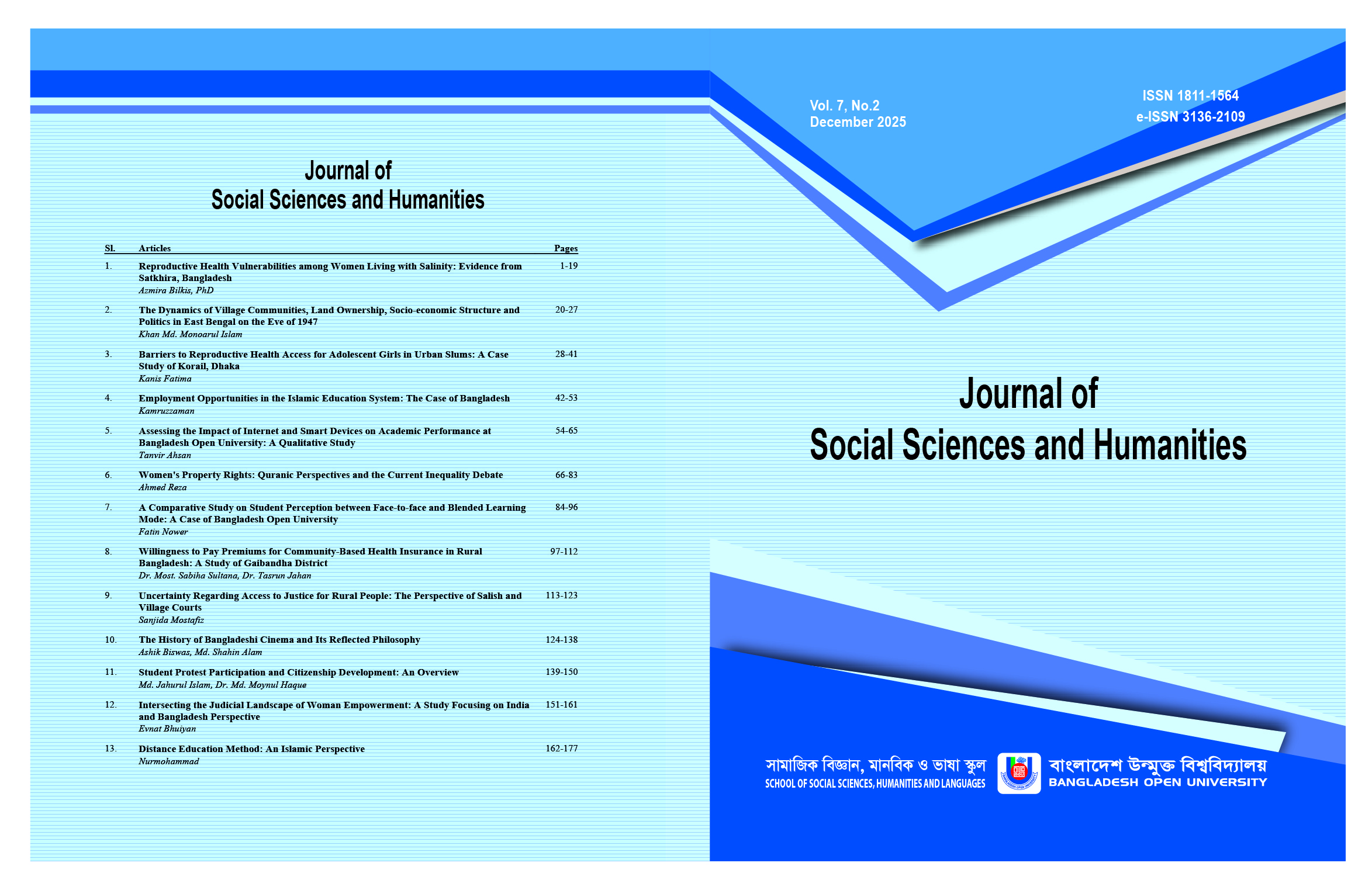
The Dynamics of Village Communities, Land Ownership, Socio-economic Structure and Politics in East Bengal on the Eve of 1947
DOI:
https://doi.org/10.59738/jssh.v7i2.69Keywords:
Village Communities, Land Ownership, Colonial Land Policies, Socio-economic Structure, East BengalAbstract
This study delves into the socio-economic and political transformations in East Bengal during the final years of British colonial rule, particularly focusing on the structure of village communities, land ownership, and political dynamics. Drawing upon the Census of 1941 and data on agricultural land distribution, the research highlights the stark contrast in land ownership across various districts, with regions like Chittagong and Tippera exhibiting higher percentages of land held by proprietors (zamindars) compared to others. The paper examines the uneven distribution of land across families, where a significant proportion of families owned less than 2 acres of land, especially in rural areas like Bakarganj and Bogra. This paper then examines how these patterns of landholding affected socio-economic formations, such as the increasing trend towards tenant farming and greater political mobilization among rural peasants. Interweaving these quantitative estimates with the historical narratives, the paper tries to develop a comprehensive picture of the politico-social scene in East Bengal before Partition in light of land policies, village structures and nationalist movement.
Downloads
Published
Issue
Section
License
Articles published in the Journal of Social Sciences and Humanities (JSSH), Bangladesh Open University, are licensed under the Creative Commons Attribution-NonCommercial 4.0 International (CC BY-NC 4.0) License. Authors retain copyright of their work. The license permits others to share and adapt the work for non-commercial purposes, provided appropriate attribution is given to the original author(s) and the source is acknowledged.
For the full license terms, please visit: https://creativecommons.org/licenses/by-nc/4.0/