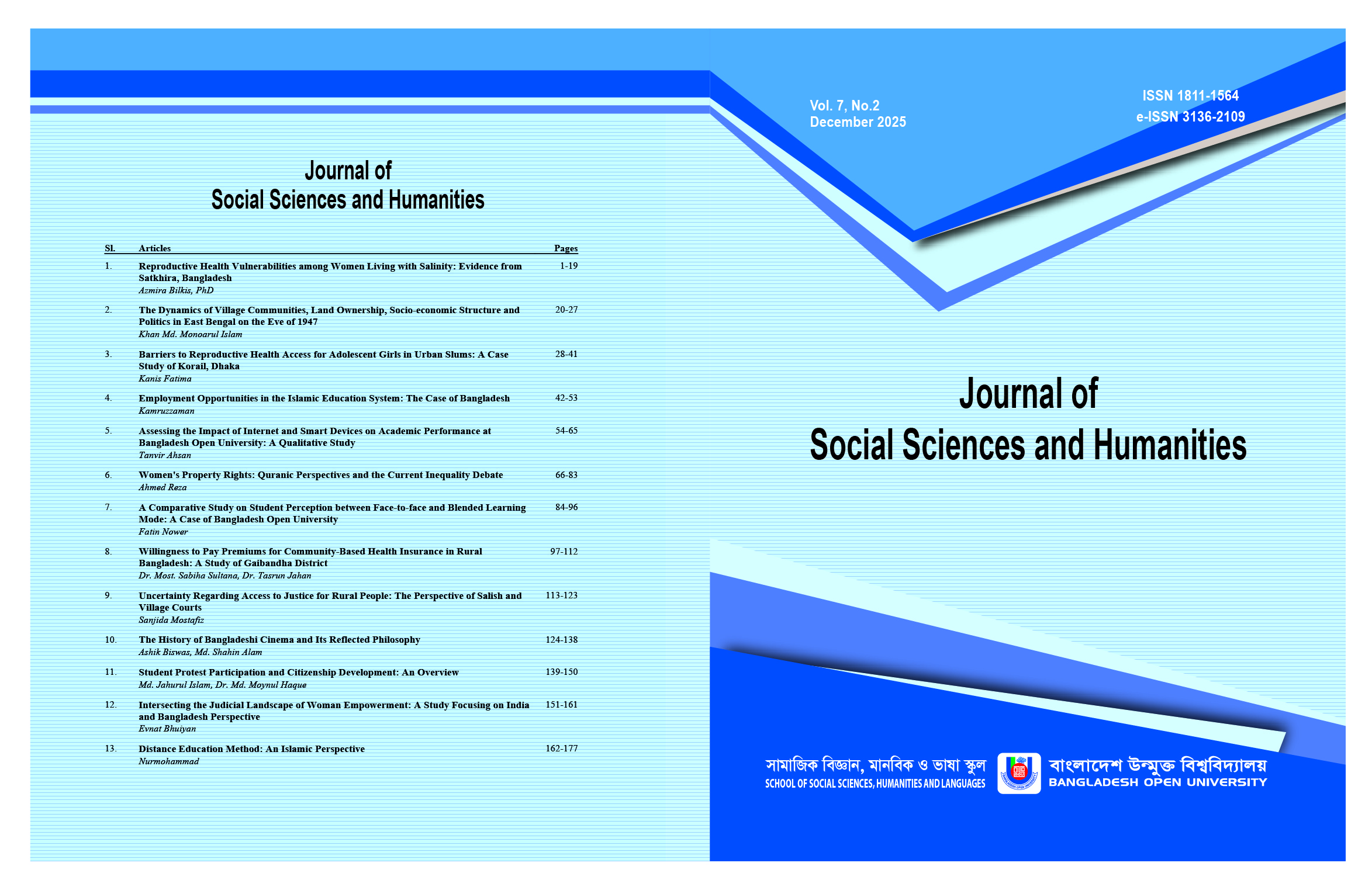
A Comparative Study on Student Perception between Face-to-face and Blended Learning Mode: A Case of Bangladesh Open University
DOI:
https://doi.org/10.59738/jssh.v7i2.77Keywords:
Blended Learning (BL), Face-to-face, Student perception, Higher education institution (HEIs), Bangladesh Open University (BOU)Abstract
In Bangladesh, teaching and learning have always entailed face-to-face interaction. Throughout COVID-19, however, the online mode of teaching had been adopted as a safe mode. However, many institutions did not fully revert to face-to-face mode, some shifted entirely online, others blended it in (Lukenga et al., 2023), similar with Bangladesh Open University’s (BOU) mixed delivery. This study was conducted to understand students’ preference between face-to-face and blended modes of learning that emerged during and after COVID-19 period. A quantitative (survey questionnaire) method was applied to this case study. The questionnaire used was adapted from Garrison & Vaughan (2008) and modified to suit the context of this study. Validity and reliability of the questionnaire were performed as the questionnaire was slightly modified. The quantitative questionnaire included closed-ended questions with options and five-point Likert-type questions. Chi-square tests had been done to measure the inclination for blended learning against traditional face-to-face between male and female students and between age groups. This study shows that though the predominant share of the participants generally favored the blended learning mode, they also lack to acquire the overall benefit of this specific medium. Female and male respondents favored blended mode over face-to-face in an equivalent style, however, preference differs across age groups. Respondents aged 20-25 and 26-31 are more likely to prefer blended mode than that of respondent aged 32 and above.
Downloads
Published
Issue
Section
License

This work is licensed under a Creative Commons Attribution 4.0 International License.
Articles published in the Journal of Social Sciences and Humanities (JSSH), Bangladesh Open University, are licensed under the Creative Commons Attribution-NonCommercial 4.0 International (CC BY-NC 4.0) License. Authors retain copyright of their work. The license permits others to share and adapt the work for non-commercial purposes, provided appropriate attribution is given to the original author(s) and the source is acknowledged.
For the full license terms, please visit: https://creativecommons.org/licenses/by-nc/4.0/