Uncertainty Regarding Access to Justice for Rural People: The Perspective of Salish and Village Courts
DOI:
https://doi.org/10.59738/jssh.v7i2.79Keywords:
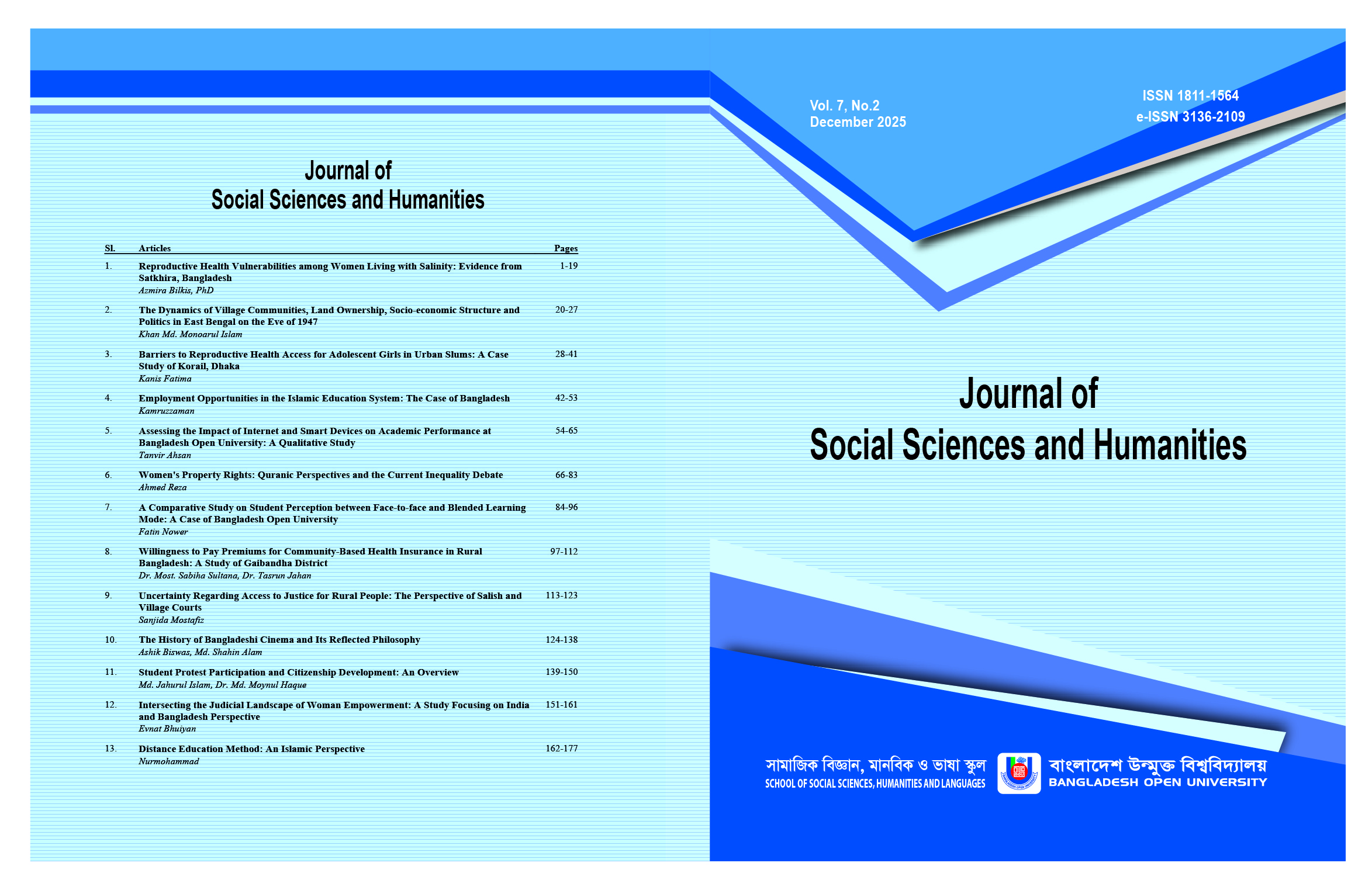
Informal justice, Village Court, Arbitration, Obstacles to justice, JusticeAbstract
Rural people in Bangladesh face various obstacles in the justice system, from the primary justice system to the formal level, such as arbitration. Although the establishment of the rule of law is an expected aspect of a modern state system, the suffering of ordinary people at various stages of the legal process is endless. And the level of suffering is even greater among rural people. Ordinary people in villages are accustomed to the informal justice system in this country. The article highlights why people resort to rural arbitration or, in particular, which of the informal and formal justice systems do rural people feel more comfortable with, what kind of obstacles they face in accessing justice and how much understanding rural people have about the conventional justice system. At the same time, the purpose of this article is to analyze the context of what obstacles arise in the access of rural people to justice in arbitration and rural courts and how these obstacles can be overcome to ensure access to justice for rural people.
Downloads
Published
Issue
Section
License
Articles published in the Journal of Social Sciences and Humanities (JSSH), Bangladesh Open University, are licensed under the Creative Commons Attribution-NonCommercial 4.0 International (CC BY-NC 4.0) License. Authors retain copyright of their work. The license permits others to share and adapt the work for non-commercial purposes, provided appropriate attribution is given to the original author(s) and the source is acknowledged.
For the full license terms, please visit: https://creativecommons.org/licenses/by-nc/4.0/