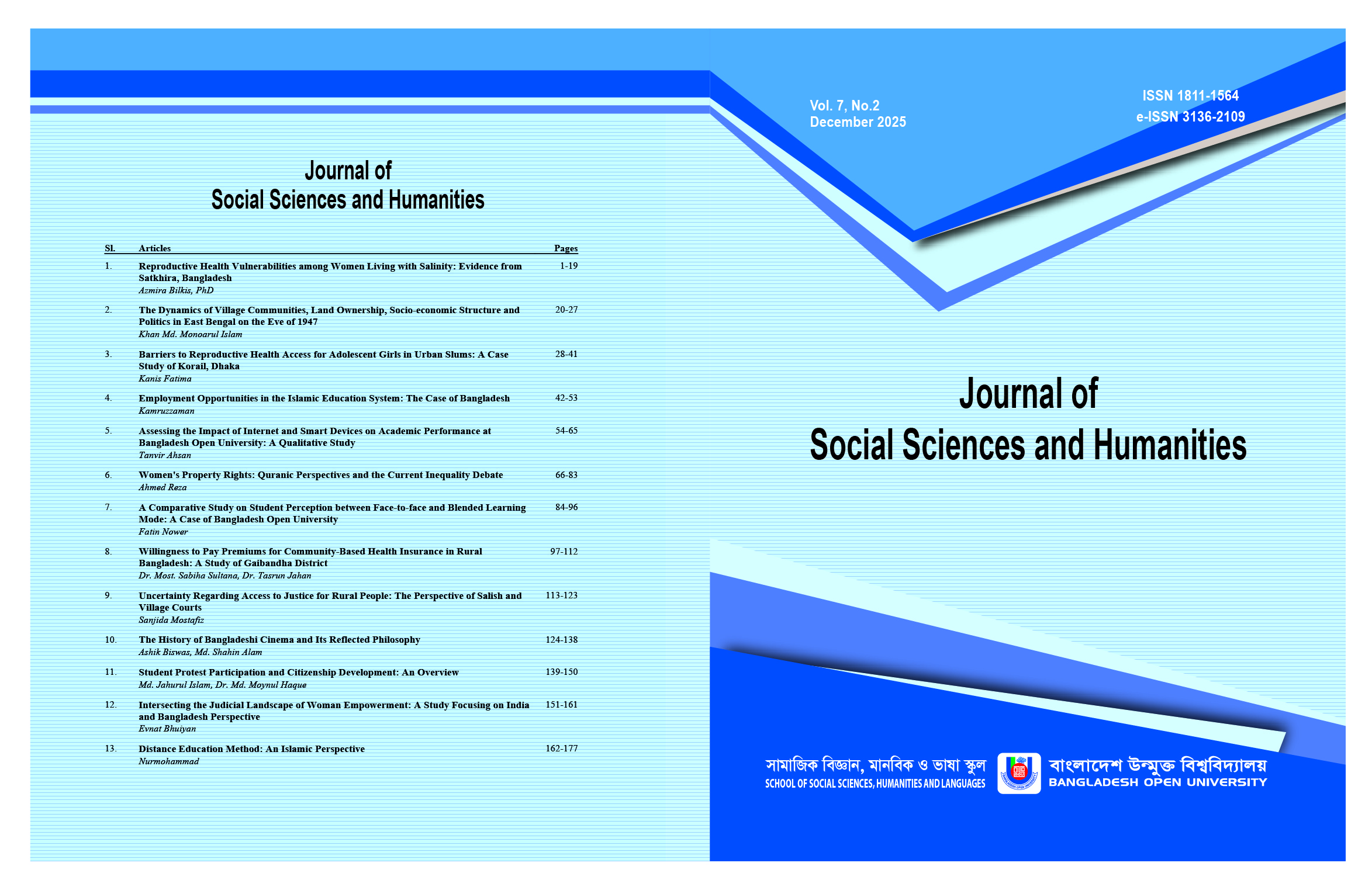
Distance Education Method: An Islamic Perspective
DOI:
https://doi.org/10.59738/jssh.v7i2.87Keywords:
Education, Distance Learning, Islam, Lifelong LearningAbstract
Education plays a vital role in developing human potential, while distance education provides an opportunity to overcome geographical barriers and pursue learning throughout life. This study examines distance education from the perspectives of Islamic theology and history through a qualitative analysis of the Qur’an, Hadith, and relevant scholarly writings. It aims to highlight the role of distance education and its potential contribution to developing countries such as Bangladesh, particularly in increasing literacy and empowering human resources. The study finds that the foundations of distance education can be traced to Islamic teachings, as reflected in the Qur’an, the educational practices of Ashab al-Suffah, and the tradition of Mukatabah. Since seeking knowledge is a duty for Muslims, the means of acquiring education should not become a barrier to learning. In this context, the mixed-method approach of open and distance learning is compatible with Islamic principles. The study also highlights the potential of instructional technologies and self-learning materials to expand educational opportunities and promote literacy in developing countries such as Bangladesh. Overall, the study demonstrates how Islamic perspectives can support distance education as a means of promoting lifelong learning and contributing to broader human empowerment.
Downloads
Published
Issue
Section
License
Articles published in the Journal of Social Sciences and Humanities (JSSH), Bangladesh Open University, are licensed under the Creative Commons Attribution-NonCommercial 4.0 International (CC BY-NC 4.0) License. Authors retain copyright of their work. The license permits others to share and adapt the work for non-commercial purposes, provided appropriate attribution is given to the original author(s) and the source is acknowledged.
For the full license terms, please visit: https://creativecommons.org/licenses/by-nc/4.0/