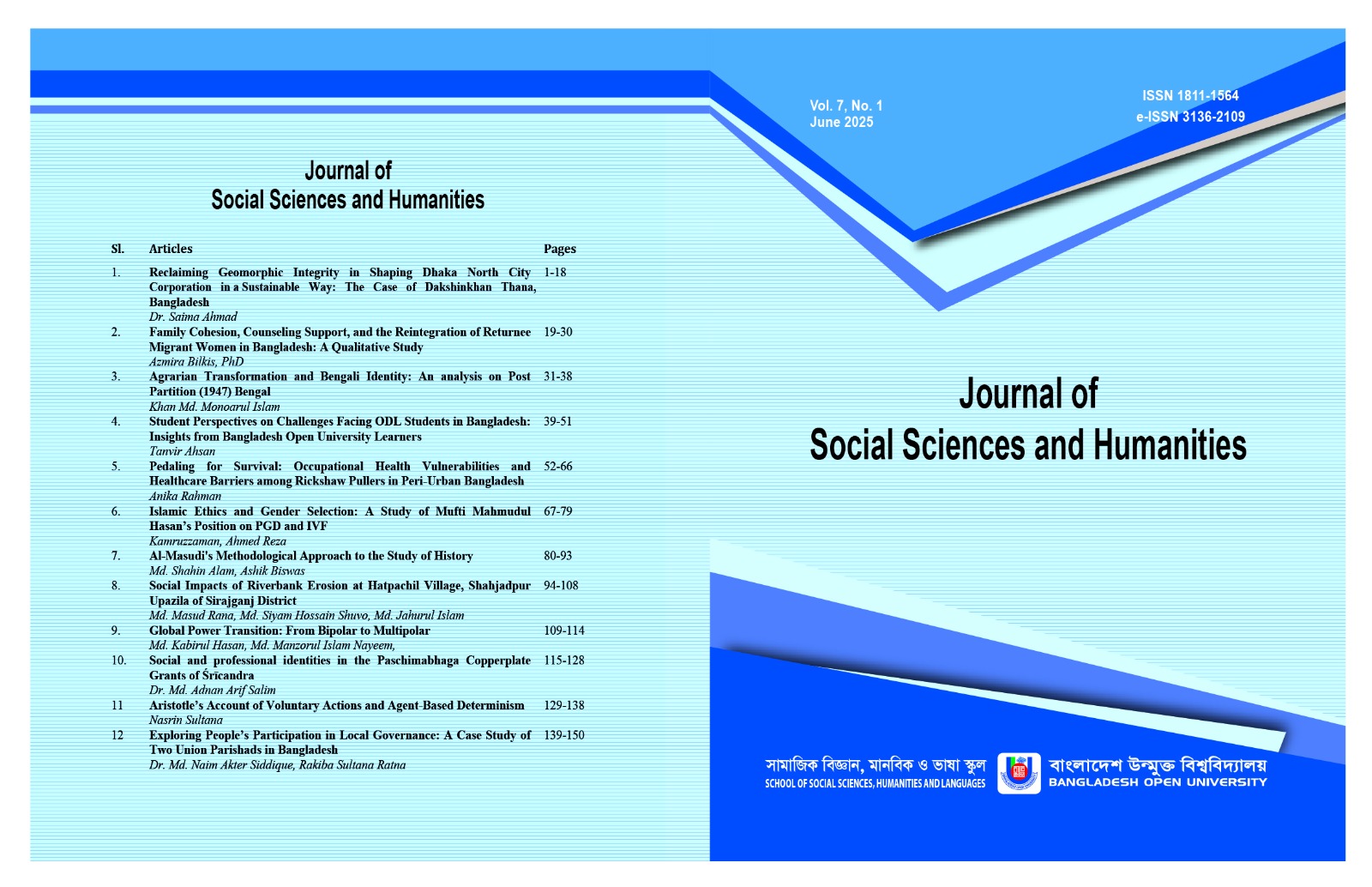
Family Cohesion, Counseling Support, and the Reintegration of Returnee Migrant Women in Bangladesh: A Qualitative Study
DOI:
https://doi.org/10.59738/jssh.v7i1.39Keywords:
Capability approach, Family cohesion, psychosocial counseling, Return migration, Women migrant reintegrationAbstract
International labor migration has become a major livelihood strategy for women from developing countries, including Bangladesh. However, the reintegration of female return migrants remains a complex process shaped by social stigma, psychological stress, and family dynamics. This study explores how family cohesion and psychosocial counseling support influence the reintegration experiences of returnee migrant women in Bangladesh. Drawing on qualitative data from 25 in-depth interviews and two focus group discussions with returnee migrant women, the study applies Family Systems Theory and the Capability Approach to analyze how family relationships and counseling interventions shape women's agency, well-being, and social participation after migration. The findings reveal that women returning to cohesive families characterized by open communication and flexible roles experience smoother psychological and economic reintegration. In contrast, women in low-cohesion families often face blame, social isolation, and limited economic support. Counseling services play a crucial role in rebuilding confidence, strengthening coping mechanisms, and expanding women’s capabilities, particularly for those lacking supportive family environments. The study contributes to migration scholarship by highlighting the interaction between family dynamics and psychosocial support in shaping reintegration outcomes. Policy recommendations emphasize the need for family-centered reintegration programs, community awareness initiatives, and expanded counseling services for returnee migrant women.
Downloads
Published
Issue
Section
License
Articles published in the Journal of Social Sciences and Humanities (JSSH), Bangladesh Open University, are licensed under the Creative Commons Attribution-NonCommercial 4.0 International (CC BY-NC 4.0) License. Authors retain copyright of their work. The license permits others to share and adapt the work for non-commercial purposes, provided appropriate attribution is given to the original author(s) and the source is acknowledged.
For the full license terms, please visit: https://creativecommons.org/licenses/by-nc/4.0/