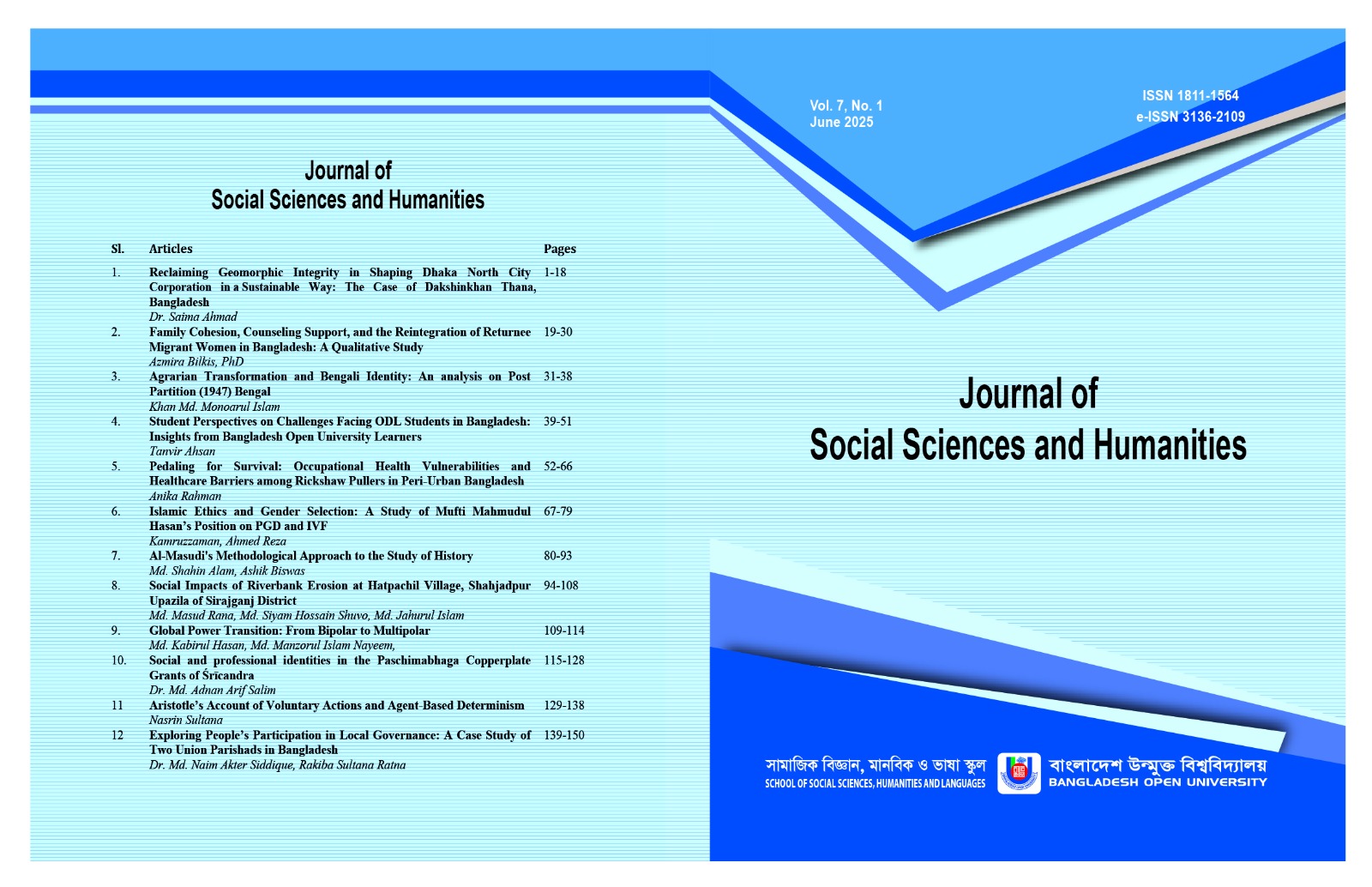
Islamic Ethics and Gender Selection: A Study of Mufti Mahmudul Hasan’s Position on PGD and IVF
DOI:
https://doi.org/10.59738/jssh.v7i1.54Keywords:
gender selection, sex selection, preimplantation genetic diagnosis (PGD), in vitro fertilization (IVF), fatwa, reproductive technologies, islamic bioethics, Bangladesh, sunni jurisprudenceAbstract
This article examines Mufti Muhammad Mahmudul Hasan’s fatwa on the permissibility of preimplantation genetic diagnosis (PGD) and in vitro fertilization (IVF) for gender selection within an Islamic ethical framework. By drawing on the fatwa issued by the Bangladeshi scholar, the study examines its permissibility requirements, which include adhering to marital boundaries, depending on divine will, avoiding harm to the wife, and rejecting non-heterosexual applications, and places it within larger Islamic bioethical discourses. This article highlights the similarities and differences between the positions of Sunni and Shia jurisprudence by conducting a comparative review of the popular scholarly literature on IVF and PGD in the Islamic context. The discussion focuses on the use of Islamic principles such as maqasid al-sharia (purposes of Islamic law), sadd al-dharai (blocking the means of harm), and maslaha (public interest). The findings emphasize a nuanced Islamic approach that permits medical intervention for sex selection of a child under strict Sharia-compliant conditions and provides warnings against unethical social abuse. As such, it makes an important contribution to the ongoing debate on reproductive ethics in contemporary Muslim societies.
Downloads
Published
Issue
Section
License
Copyright (c) 2026 Journal of Social Science and Humanities

This work is licensed under a Creative Commons Attribution 4.0 International License.
Articles published in the Journal of Social Sciences and Humanities (JSSH), Bangladesh Open University, are licensed under the Creative Commons Attribution-NonCommercial 4.0 International (CC BY-NC 4.0) License. Authors retain copyright of their work. The license permits others to share and adapt the work for non-commercial purposes, provided appropriate attribution is given to the original author(s) and the source is acknowledged.
For the full license terms, please visit: https://creativecommons.org/licenses/by-nc/4.0/