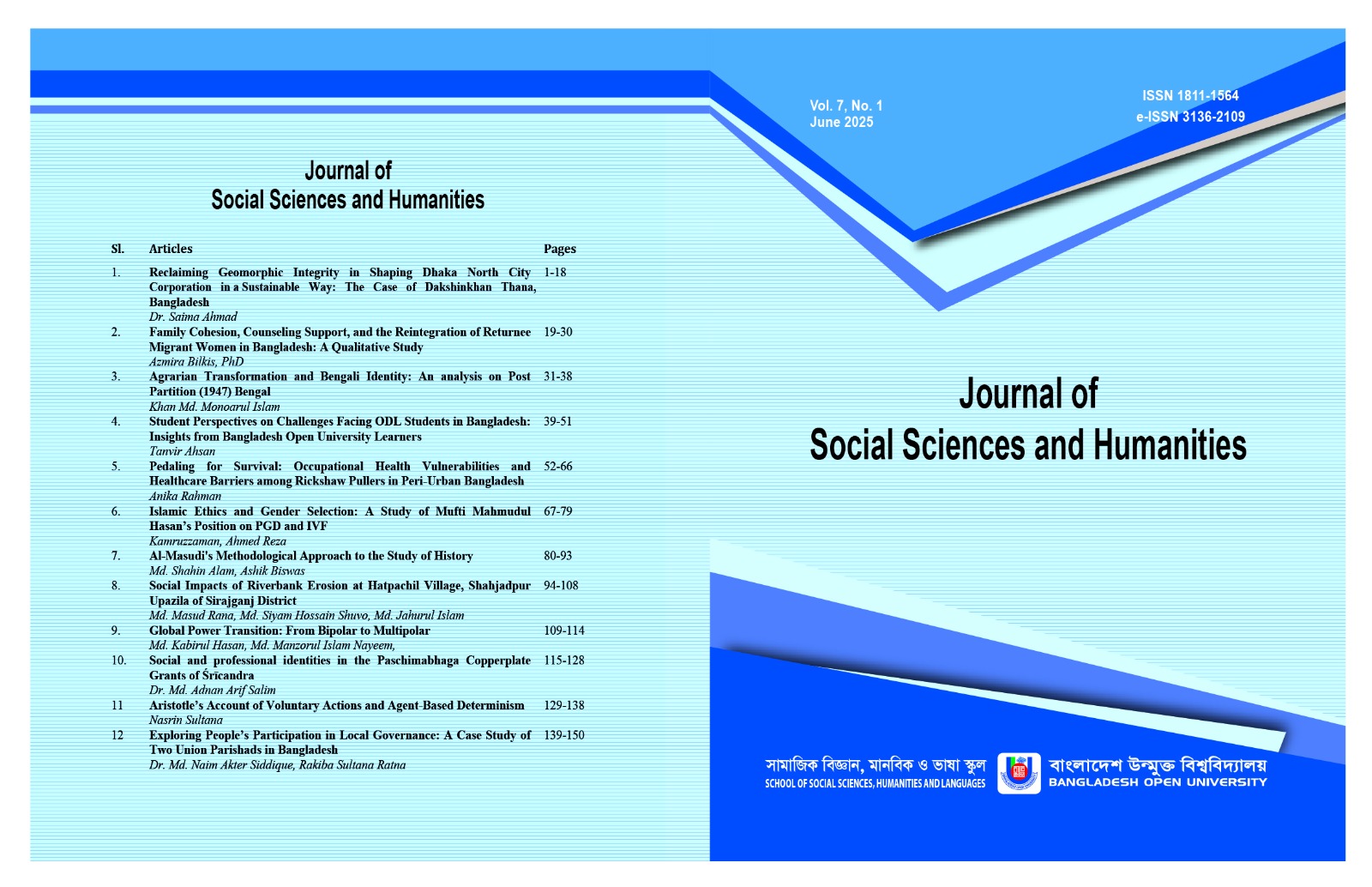
Social and professional identities in the Paschimabhaga Copperplate Grants of Śrīcandra
DOI:
https://doi.org/10.59738/jssh.v7i1.62Keywords:
Chandra dynasty, Śrīcandra, Paschimabhaga Copperplate Inscription, early medieval Bengal, land grants, socio-economic structures, religious diversityAbstract
The Paschimabhaga Copperplate Inscription of King Śrīcandra, a major epigraphic record of the Chandra dynasty, gives us important information about the political power, social and economic order, and cultural diversity of early medieval Bengal. The charter, which was issued in Śrīcandra's fifth year as king, not only confirms the legitimacy of the dynasty through genealogical and religious eulogies, but it also lists large land grants for settlement and institutional support. In addition to its political aspects, the inscription clearly shows the wide range of social and professional groups that were part of the Chandra polity. These groups included Brahmins from different gotras, Buddhist monastic communities, and people who worked as astrologers, potters, blacksmiths, barbers, washermen, and performers. This paper contends that an examination of the textual and socio-historical dimensions of the Paschimabhaga grant reveals it to be not merely a record of land distribution, but a narrative construction of social and professional identities that influenced the lived experiences of early medieval Bengal.
Downloads
Published
Issue
Section
License
Articles published in the Journal of Social Sciences and Humanities (JSSH), Bangladesh Open University, are licensed under the Creative Commons Attribution-NonCommercial 4.0 International (CC BY-NC 4.0) License. Authors retain copyright of their work. The license permits others to share and adapt the work for non-commercial purposes, provided appropriate attribution is given to the original author(s) and the source is acknowledged.
For the full license terms, please visit: https://creativecommons.org/licenses/by-nc/4.0/