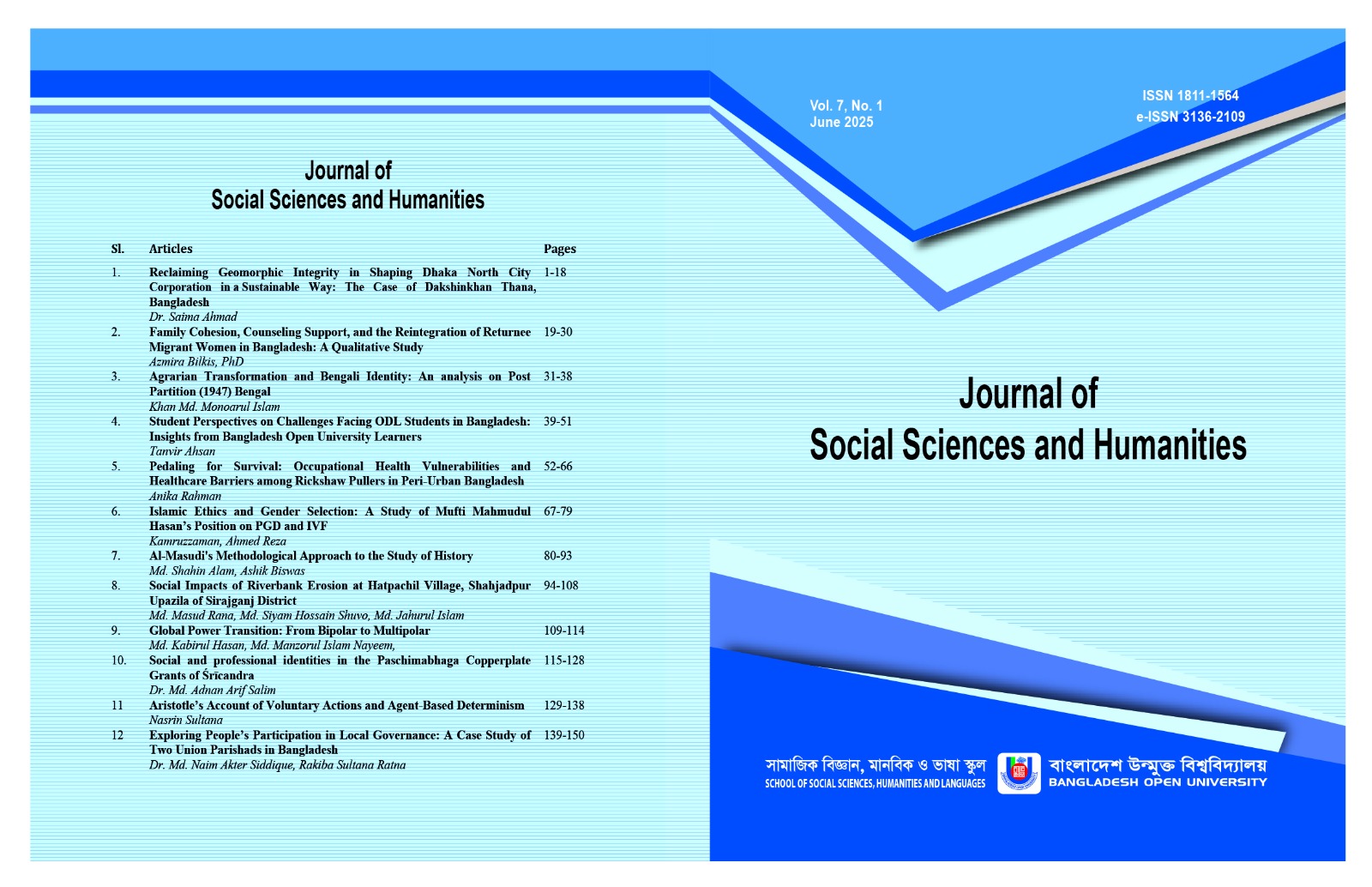
Aristotle’s Account of Voluntary Actions and Agent-Based Determinism
DOI:
https://doi.org/10.59738/jssh.v7i1.64Keywords:
Aristotle, voluntary action, determinism, agent-based determinism, moral responsibility, agent causation, immanent causation, Nicomachean EthicsAbstract
In Nicomachean Ethics Book III, Aristotle contends that voluntary actions originate within the agent and are “up to the agent” (eph' hautō) rather than determined by any external event. This has led some interpreters to read Aristotle as implicitly rejecting determinism—the view that every event is necessitated by antecedent causes. In this paper, I argue that this reading is not persuasive. Rather, Aristotle’s account of voluntary action is compatible with a form of determinism, namely agent-based determinism, according to which an action is determined by the agent’s own psychological properties, such as desires, deliberation, and character, rather than by any prior external event. Drawing on Chisholm's notion of immanent causation and Daigle's reformulation of agent-based determinism, I show that Aristotle's voluntary agent is best understood not as an uncaused cause but as an agent whose actions are caused by her own psychological constitution—character and reasoning.
Downloads
Published
Issue
Section
License
Articles published in the Journal of Social Sciences and Humanities (JSSH), Bangladesh Open University, are licensed under the Creative Commons Attribution-NonCommercial 4.0 International (CC BY-NC 4.0) License. Authors retain copyright of their work. The license permits others to share and adapt the work for non-commercial purposes, provided appropriate attribution is given to the original author(s) and the source is acknowledged.
For the full license terms, please visit: https://creativecommons.org/licenses/by-nc/4.0/